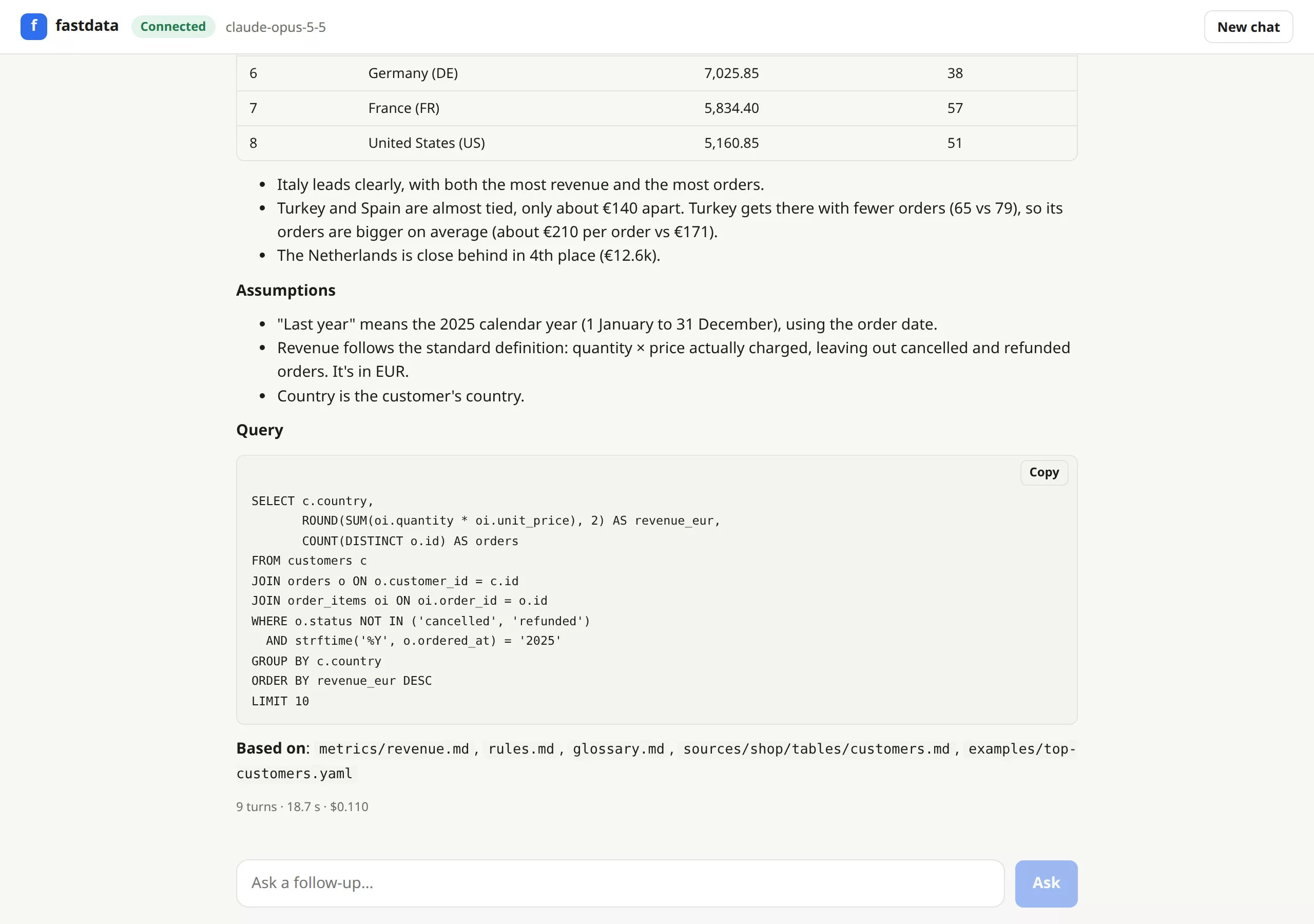
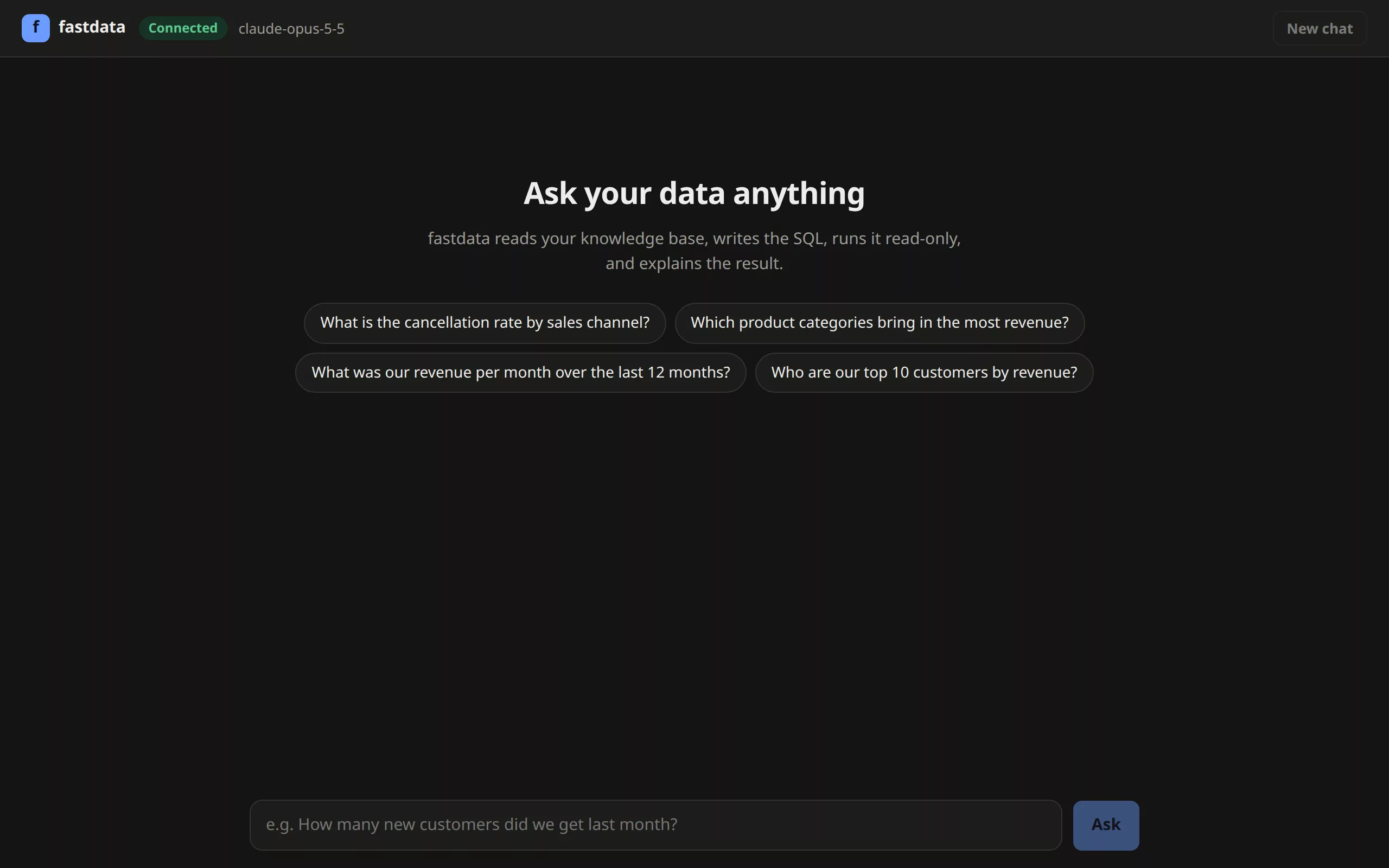
fastdata is data self-service in one command. A Claude agent reads your knowledge base, writes read-only SQL, runs it through a connector you control, and answers in Markdown, with its assumptions and the exact query.
$ curl -fsSL https://fastdata.run/install.sh | sh
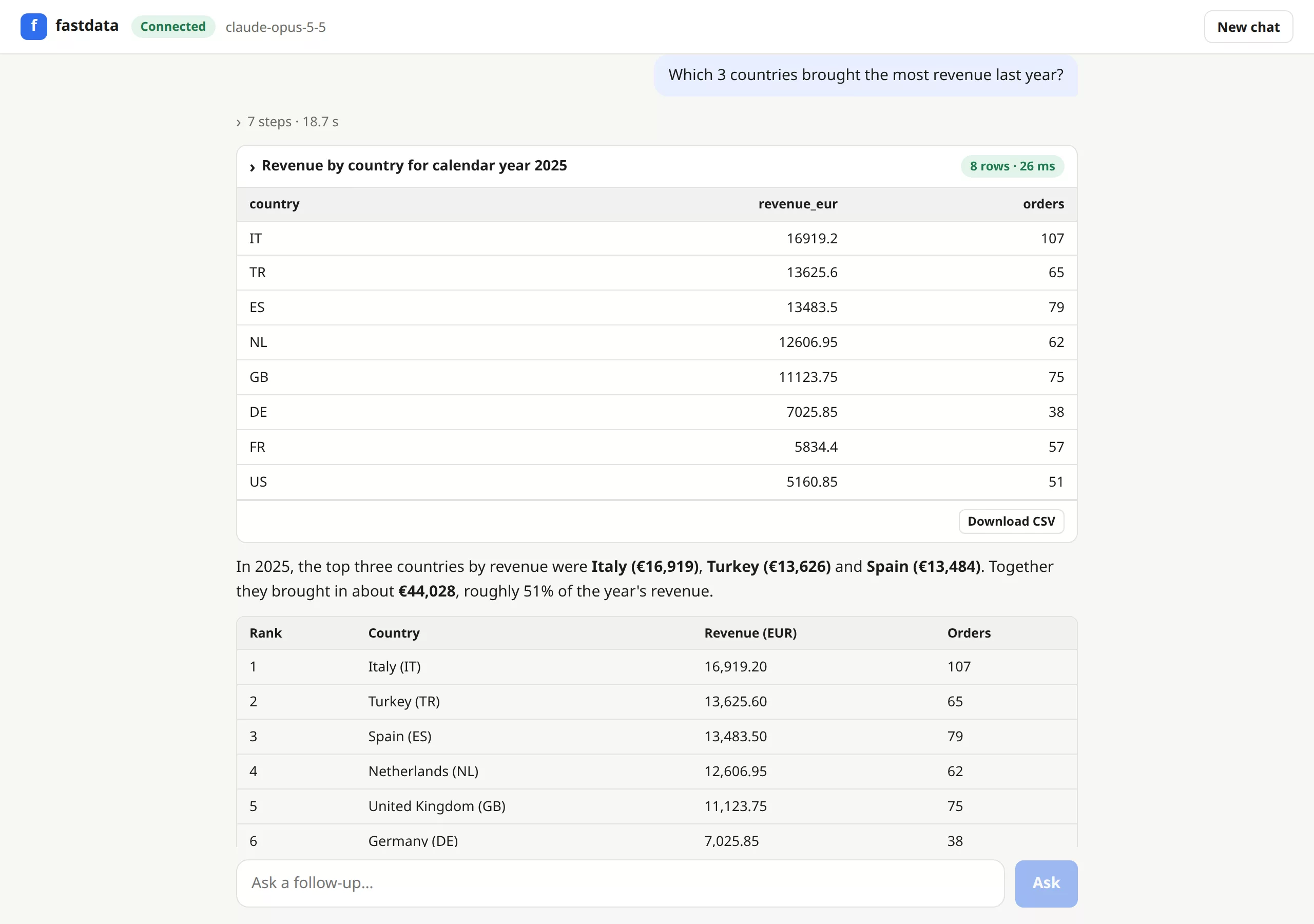
The agent works like a new analyst with a good handbook: it reads what your team wrote down about the data, then queries it. Nothing is guessed silently; every answer lists its assumptions and the files it relied on.
fastdata learn drafts the knowledge base from your schema: one Markdown file per table, a glossary and rules. You add the metric definitions only people know.
The agent reads INDEX.md, opens only the files it needs, and writes SQL in your dialect, reusing your verified examples.
Every query passes fastdata's guard, then runs through your connector with your credentials. Claude sees a preview of the rows, not your whole table.
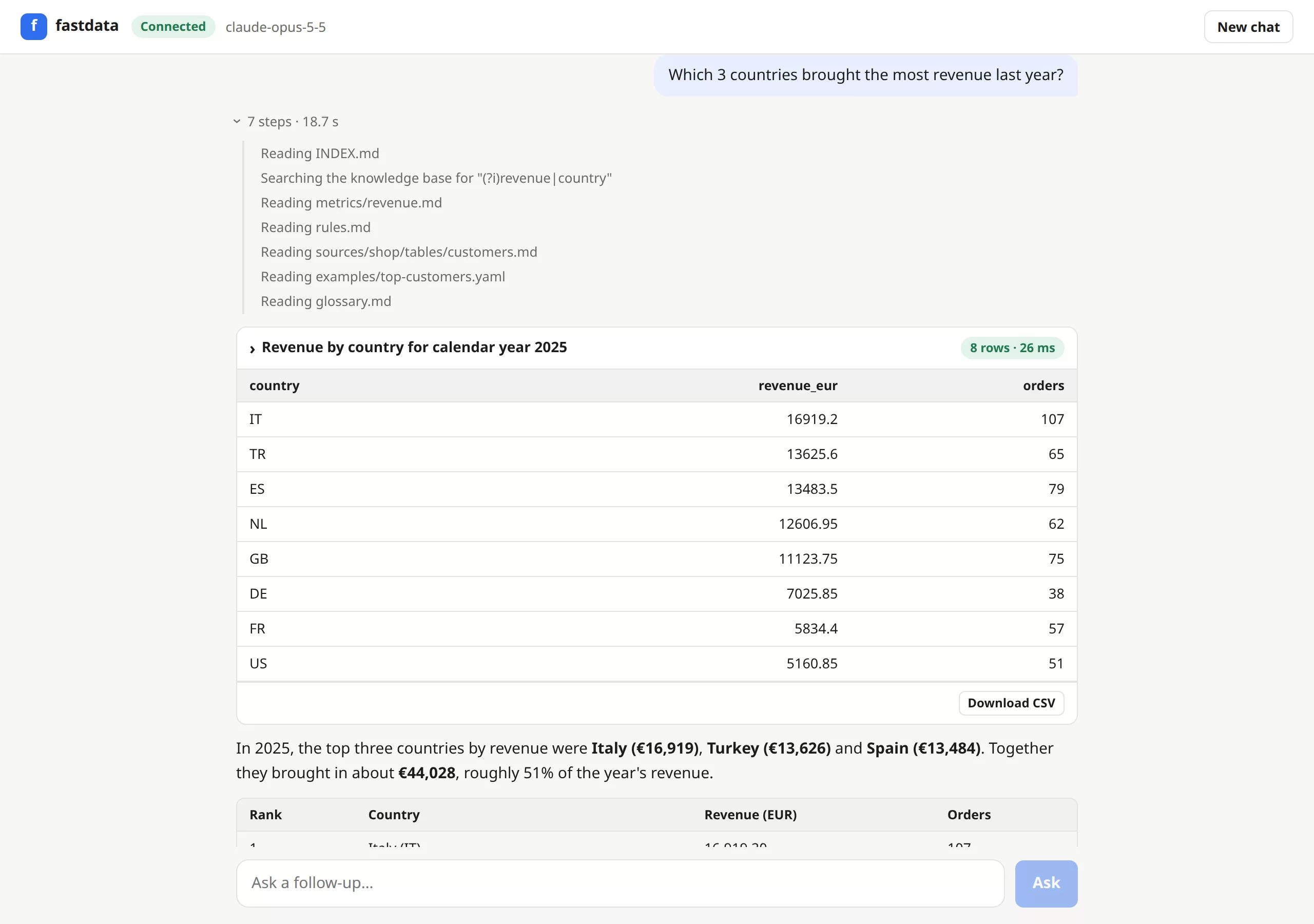
The key number in bold, a table, insights, Assumptions, the Query and the knowledge files it was Based on.
fastdata opens a local chat with query cards, full result tables and CSV
download. fastdata ask prints the answer to stdout and progress to stderr,
so fastdata ask "…" > answer.md just works.
/?q=How+many+orders+today ask straight away--json streams every event for automation$ fastdata ask \ "Which 3 countries brought the most revenue last year?" · Reading INDEX.md · Reading metrics/revenue.md · Reading sources/shop/tables/customers.md ▶ Running: Revenue by country for calendar year 2025 8 row(s) in 26 ms 9 turn(s) · 18.7 s · $0.1100 In 2025, the top three countries by revenue were **Italy (€16,919)**, **Turkey (€13,626)** and **Spain (€13,484)**. … **Assumptions** - "Last year" means the 2025 calendar year. - Revenue excludes cancelled and refunded orders.
Real screenshots from the coffee-shop demo that fastdata init --demo creates.
fastdata lets an AI write SQL against your data, so it is built so that no single mistake, including instructions hidden in the data, can change data or leak credentials.
Every query is checked in code before it reaches the connector: exactly one read statement, no write or admin keywords, no side-effect functions. Where SQL dialects disagree, it takes the stricter reading.
The built-in Postgres and SQLite executors run every query in a read-only transaction or on a read-only file, one statement per call, with a timeout and a row cap.
A role with SELECT only. The real guarantee: it holds even if everything above fails. The docs include the SQL to create it.
Built-in read-only executors for Postgres and SQLite, any MCP server with a "run SQL" tool (MySQL, SQL Server, MariaDB, Oracle…), or a plain HTTP endpoint.
No connector? Manual mode: fastdata finds the right tables and writes the query, you run it wherever you like and paste the results back for the analysis.
Connectors$ curl -fsSL https://fastdata.run/install.sh | sh $ fastdata init shop-demo --demo # sample SQLite database + knowledge base $ cd shop-demo $ fastdata # web chat at http://localhost:8000
Or npm install -g fastdata with Node 22.13+. Needs Claude access: a logged-in Claude Code on the machine works as is, or set ANTHROPIC_API_KEY (Bedrock and Vertex AI work too).
fastdata ask, manual mode, HTTP API.
ReferenceConfigurationEvery fastdata.yaml option.
ExampleRingly on PostgresA 15-table SaaS database to copy from.
ReferenceArchitectureRuntime, event contract and invariants.